Biblical and Confessional Resources
-
Bible Gateway
BibleGateway.com: A searchable online Bible in over 150 versions and 50 languages.
Note that LM-A has adopted the English Standard version as our preferred translation for publications.
-
The Book of Concord Online
The Book of Concord - Lutheran Confessions - Concordia Publishing House - NEW - free site with the text from Concordia: The Lutheran Confessions © 2005, 2006 by Concordia Publishing House and is a revised and updated version of the translation originally prepared by William H. T. Dau and G. Friedrich Bente for the Concordia Triglotta
Includes the following:
-
Luther's Small Catechism
A digital version of Luther’s Small Catechism in an easy-to-understand layout. Includes translations in a range of languages.
Also available as an app. The full explanation of the Small Catechism is available as an in app purchase.
-
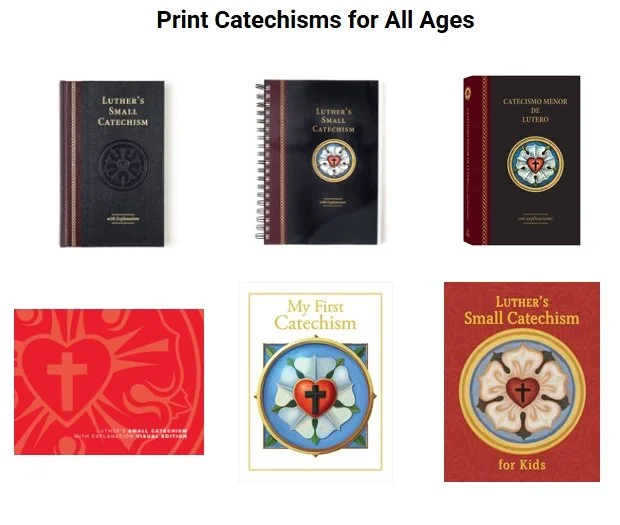
Print Catechisms for All Ages
Concordia Publishing House has a wide range of excellent print versions of the catechism for different ages.
Visit their website at Luther's Small Catechism - Concordia Publishing House
Or contact Creative Word Fellowship to order locally.
Then I saw another angel flying directly overhead, with an eternal gospel to proclaim to those who dwell on earth, to every nation and tribe and language and people. And he said with a loud voice, “Fear God and give him glory, because the hour of his judgment has come, and worship him who made heaven and earth, the sea and the springs of water.”
Revelation 14:6-7
When Luther died in 1546 it gave people pause to consider the true impact and emphasis of his life’s work. What was the essence of what he stood for? What was this Reformation really about? What was the lasting message that Luther himself would have people hold on to?
At his funeral, Luther’s friend and colleague Pastor Johannes Bugenhagen preached and while it might be unexpected to our ears today, Bugenhagen identified Luther with the angel of Revelation 14 who proclaimed ‘an eternal gospel’ to all on earth. This was not some schmalzy spirituality suggesting that people become angels when they die (which of course is not true). Rather Bugenhagen was identifying Luther as God’s messenger (angel) whose primary work was to proclaim the unadulterated gospel and to restore it to its rightful place as the central message and work of the church.
As Bugenhagen honoured Luther with this recognition, he was also rightly defining the essence of the Reformation. Still today some want to focus on the impact the Reformation had on history and the way it helped define the German nation, but it was not primarily a cultural or political movement. In fact the Reformation was not a movement, but rather a message (see Pless: 68-69). A message that God freely justifies sinners through faith alone in Christ alone. A message that calls for confidence in the Word of the Lord that endures forever (1 Peter 1:25) and who’s central message is this same eternal gospel fulfilled in Christ Jesus who ‘died for our transgressions and was raised for our justification’ (Romans 4:25).
This article is the second in a series exploring the six chief parts of Luther’s Small Catechism. It was written by Rev. Dr. Edward G. Kettner, Professor Emeritus of Systematic Theology at Concordia Lutheran Seminary (Edmonton) and was first published in The Canadian Lutheran in April 2017 .
We All Believe in One True God
When Luther outlined the order of the catechism, he noted that first we need to see what God would have us do and leave undone. Then we need to see what provision God has made for us because we have not done or have left undone what God says we should. The commandments clearly give us instruction for our life as we should live it as people of God, and show us that we have not lived up to their standards. From there Luther takes us to the Creed, where we see what God has done to preserve our lives, both on earth and in relationship to Him.
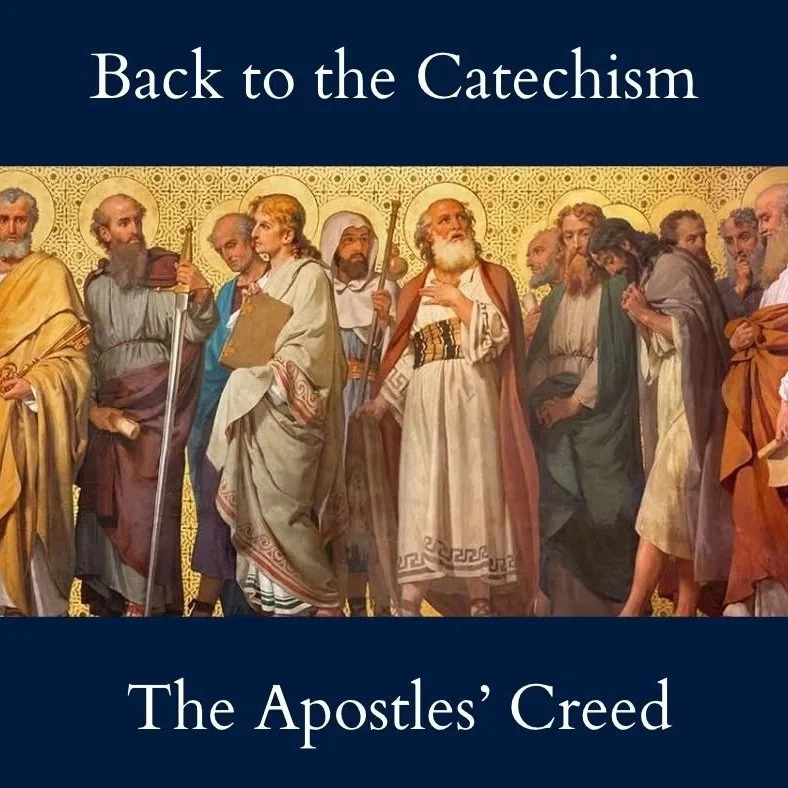
While there are three creeds that have been widely used in the Church down through the ages, the focus in the Catechism is on the Apostles’ Creed. This Creed has become the creed used in baptism, the creed which summarizes what the Scriptures teach about the God Who Is, and the God whom we confess as our saving God.
This article by Rev. Dr. Edward G. Kettner, Professor Emeritus of Systematic Theology at Concordia Lutheran Seminary (Edmonton), was first published in The Canadian Lutheran in January/February 2017 and is reproduced here with permission. It is the first in a series exploring the six chief parts of Luther’s Small Catechism. The rest of the series will be reproduced in subsequent issues of the newsletter.
Why the Law Matters
Not long after Luther rediscovered the Gospel of free grace, he realized how terribly ignorant both the people and the clergy were of the basics of the Christian faith. Beginning already in 1518, Luther preached frequently on the basics of faith. After conducting a visitation of congregations in Saxony in 1527 and 1528, Luther lamented this lack of knowledge and determined to provide a means by which people could be educated in the faith and in the Christian life. Consequently, he wrote the catechisms to explain the content of the faith and a pattern for living out one’s faith in the world in simple form—one that could be used by heads of household as well as by clergy and school teachers.
The idea of a catechism, or a handbook to the Christian faith, was not something new. Instruction in the Creed and Lord’s Prayer, and later also the Ten Commandments, had been common in the Middle Ages, though such instruction had fallen into disuse. Prayer books had also been common, but they tended to be very moralistic rather than Gospel-centered.
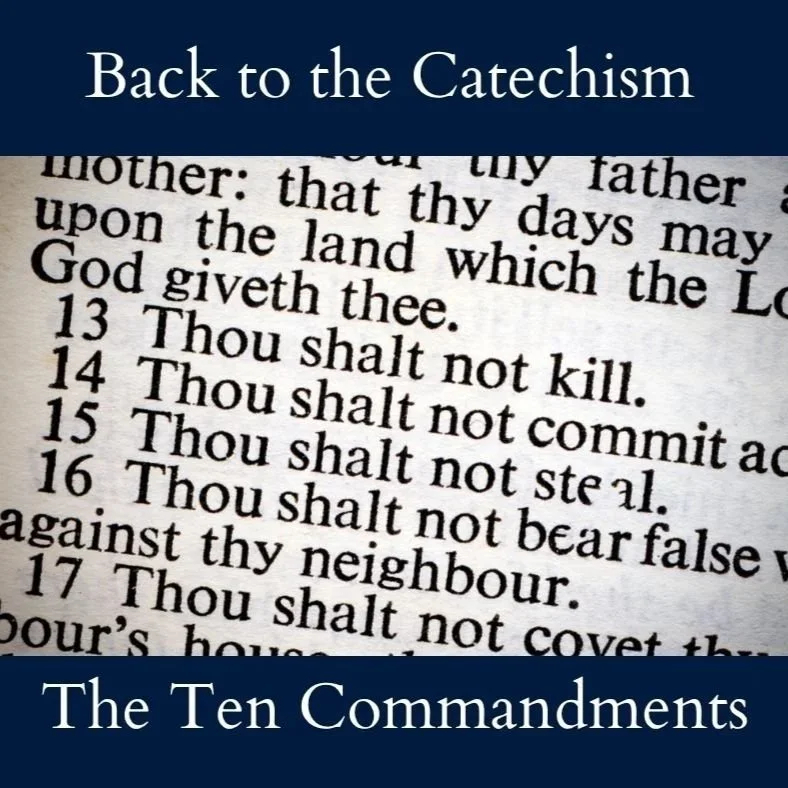
In his catechisms, Luther began his teaching with the Ten Commandments, to show the student what a person should do and leave undone in one’s life, showing both what God forbids and desires, and how one continually falls short of doing God’s will.
… so shall my word be that goes out from my mouth;
it shall not return to me empty, but it shall accomplish that which I purpose,
and shall succeed in the thing for which I sent it.Isaiah 55:11
Our churches teach that the Word, that is, the Son of God [John 1:14], assumed the human nature in the womb of the Blessed Virgin Mary (AC III).
When Martin Luther posted his 95 Theses to the Castle Church door in Wittenberg in 1517, he started a reformation that had far reaching ramifications. Historians and commentators have highlighted the many political, educational, and social changes that took place in and around the reformation. New technologies such as the Gutenberg Press enabled the work of Luther and early reformers to be spread quickly and effectively. (Just imagine Luther with a laptop and the internet!)
What may be overlooked or diminished is that always at the heart of the reformation was the work of Jesus Christ and his death on the cross that all people may be saved. The primary work of the reformation was the proclamation of the Gospel so people might repent of their sins, receive the forgiveness of sins, then the crown of righteousness (2 Timothy 4:8).
Isaiah exhorts God’s people to seek the Lord while he may be found. Today many people speak of being spiritual but not religious, or some variation on that theme. We hear it from movie and music stars, and this may be mimicked by your friends and family also. It suggests a keen desire to chart one’s own course, but to have a mystical someone or something to fall back on if things get difficult.
Against worldly thinking, Isaiah sounds a clear warning, ‘seek the Lord while he may be found, call upon him while he is near’ (Isaiah 55:6). The living Word is incarnate through the person of Jesus Christ. We have ready access to Jesus through His Word and through the sacraments. In baptism we are joined with Jesus into the one true and apostolic church, the family of God. Through Holy Communion we receive the true body and blood of Jesus which we carry into the lives of our family and friends. This is our faithful witness.
Our help is in the name of the Lord, who made heaven and earth (Psalm 124:8 ESV).
The painting of Jesus praying in the Garden of Gethsemane captures his focus on the Father. In perfect faithfulness, he willingly became the helpless one - arrested, beaten, and crucified. His agony was real. He knew his blood would be shed in place of ours. His sweat fell like drops of blood as he prayed, ‘Not my will, but yours, be done’ (Luke 22:42). In His suffering and death, he restored our connection to the Father, so that our attention might turn away from ourselves - from our sin, our efforts, our striving - and toward living as faithful children in the presence of our Heavenly Father.
Before God we are helpless. Our sin has caused a lack of fear, love, and trust in God. Like Adam and Eve, we turn from him, forget his help, and attempt to help ourselves. Yet from the beginning God created us for relationship and mutual faithfulness. Eve was given to Adam as a helper, but in the moment of temptation neither helped the other remain faithful. They turned from God, hid from him, and their will - and ours ever since - set itself against God.
We still have freedom in everyday matters. We can help ourselves to what’s in the fridge or the pantry. But when it comes to saving ourselves from death, we are utterly helpless. We cannot stop the ‘conveyor belt’ of this world that carries us to the grave. We cannot make ourselves holy, prevent ourselves from hurting others or being hurt, nor can we escape death. Deep down, humanity knows what Scripture and the Lutheran Confessions affirm: the human will is bound by sin and death.
Recognising our helplessness, however, does not stop temptation. We are tempted to minimise our sin: ‘I’m not that bad. I’m better than others.’ We are tempted to believe that politeness, positivity, or good manners can substitute for repentance. But Jesus says, ‘There is joy before the angels of God over one sinner who repents’ (Luke 15:10). Heaven rejoices over repentance, not respectable disobedience. The opposite temptation - despairing in our helplessness and refusing God’s help – is just as dangerous. Self-pity is no more faithful than self-righteousness. So, what turns us from both pride and despair? How is the curse of Eden reversed?
If you abide in my word, you are truly my disciples, and you will know the truth, and the truth will set you free.
John 8:31-32
As the commemoration of the Reformation approaches, I sit here in Wittenberg with the bells of the city church where Luther preached over two thousand sermons ringing through the cold autumn air. It is a wonderful privilege to be in this significant place at this time of year when we give thanks to God for His preservation of the gospel through the faithful service of Luther and many others.
I have to confess that it is easy to be overwhelmed by the history and romanticism of this place, not to mention the encouragement that comes from being together with our dear friends from the Lutheran Church – Missouri Synod and leaders from their sister churches across the world. But the Reformation is not primarily lived out by basking in the past or in these blessed experiences in evocative settings. The Reformation was and continues to be lived out as the comfort of the gospel is proclaimed to troubled consciences, so that we might live and die with confidence in Christ and all He has done for us.
Luther and the reformers recognised that in the face of our own sin and the attacks of the devil, God has provided His Holy Word to provide us this comfort and confidence, and enables us to read and digest the Word for just this purpose. This was revolutionary at the time of the Reformation as most people didn’t have access to the Scriptures and even if they did, they were taught that it was all too difficult and unclear for the ordinary lay person to understand and that the Word needed to be mediated through the teaching of the Roman Church and her clergy.
As the scales fell from Luther’s eyes and he came to properly understand from Scripture that we are saved by grace alone through faith alone in Christ alone, he realised it was the Roman Church that was obscuring the Scriptures and in so doing, they were robbing the church of the Bible’s central teaching on justification. Reading the Scriptures with fresh eyes, filled with the wonder of a God who loved him so much that He sent His one and only Son to die in His place, Luther came to understand that God’s Word is not only clear in its simple and intended sense, but that it is all a Christian needs to know to receive God’s gifts won for them by Christ Himself.
In this article, based on the first session of his seminar ‘Before Christ and the World’, Dr Stephen Pietsch explains why Christians ‘confess’ our faith.
Confessing?
Confessing literally means to ‘say the same thing.’
In the New Testament, the Greek verb, homologeo is used when a solemn public declaration is made of what Christians believe [John 1:20; 9:22; 12:42; Romans 10:9-10; 1 Timothy 6:12; 1 John 2:23; 4:2, 3, 15; 2 John 7]. The noun, homologia, denotes either an act of confession of the gospel, or a liturgical form of confession in the community [2 Corinthians 9:12-13, 1 Timothy 6:12, 13; Hebrews 3:1; 4:14; 10:23].
Scripture calls us to confess our faith in Christ, which includes all of Scripture’s witness concerning Him [Matthew 10:32-33].
The English word, confession, comes from Latin, confessio [I confess], which can mean the admission, acknowledgment, or public declaration of something. On one hand it is used in the sense of a confession of sins [e.g. Psalm 32:5; James 5:16; 1 John 1:9]
On the other hand, it is used in the sense of a confession of faith, a confident declaration [Acts 4:13, 31] of what a person believes and stands for [Romans 10:9, 10; Matthew 10:32-33; Luke 12:8, 9; Philippians 2:11]. Confession in this sense means ‘to state what you believe’ (what God says). The Lutheran Confessions are statements of faith that Lutherans use to declare to the world, ‘This is what we believe, teach and confess.’
The Christian church has then been confessing its faith from the very beginning. Jesus confesses and teaches the truth all through his ministry. The Apostles confessed the faith in their ministries, many of them losing their lives as a result.
On 7-8 June, Dr Stephen Pietsch led a wonderful weekend of learning and mutual encouragement at the ‘Before Christ and the World - What it means to be a confessional Lutheran’ Seminar, which was held at St John’s Lutheran Church in Tanunda SA. The event was attended by approximately 100 people, with a large number of people viewing the livestream.
The seminar began with an opening responsive prayer service, led by Pastor Lee van Rossen, and a warm welcome on a very cold, wet day from Pastor Mathew Ker, who acted as MC throughout the weekend.
Dr Pietsch began the seminar by exploring why Christians have confessed their faith since the very earliest days of the church, what confessing actually means, and why “confessing the faith clearly and openly teaching the doctrines of Scripture is an essential calling of all Christians, and is according to Luther, a ‘mark of the church’, that it teaches, confesses and proclaims the word of God.”
After a sumptuous morning tea, provided by Barossa Lutheran Mission who were our hosts for the weekend, participants returned for the second session, in which Dr Pietsch focused in on the Lutheran Confessions, discussing the context in which they were developed and why they continue to be the confession of the Lutheran church almost 500 years later. As Dr Pietsch explained, the Confessions “clearly express the whole witness of Scripture which is the rule and norm for our teaching and practice.” He emphasised that the Bible is the “norm of norms” - the overarching authority under which the Confessions sit.
There are several methods and plans for Bible reading. We are encouraged to read God’s Word regularly, to feed and drink from the Source of Life. We are nurtured and strengthened in faith, and the Holy Spirit causes us to grow in our Christian life and witness to stand on God’s truth and share it. We need to be reminded always that tools are just tools. These are useful as long as they bring us into God’s Word. Jesus says: “If you abide in My Word, you are truly My disciples, and you will know the truth, and the truth will set you free” (John 8:31-32).
Methods of Bible Reading
There is not just one way of studying God’s Word. Methods vary greatly. Some people choose to simply read portions of Scripture regularly; some take notes about the reading; others write down personal applications and prayers related to the day’s reading; and still others develop a more comprehensive practice as they survey the contextual, exegetical, and doctrinal elements involving the text.
… There are many right ways to study Scripture. But there is also a wrong way. The wrong way is to approach the Bible without reverence and humility, relying more on your own understanding than on the power of the Word itself. The wrong way is when you distort God’s Word - for example, by taking a historical prophecy and assuming it’s personally about you. The wrong way is when you try to make Scripture say more or less than what it actually says—when you force it to accommodate to your worldview. God’s Word says what it says. It cannot be changed, added to, or subtracted from. It is God Himself speaking to us. “All Scripture is breathed out by God and profitable for teaching, for reproof, for correction, and for training in righteousness” (2 Timothy 3:16).