
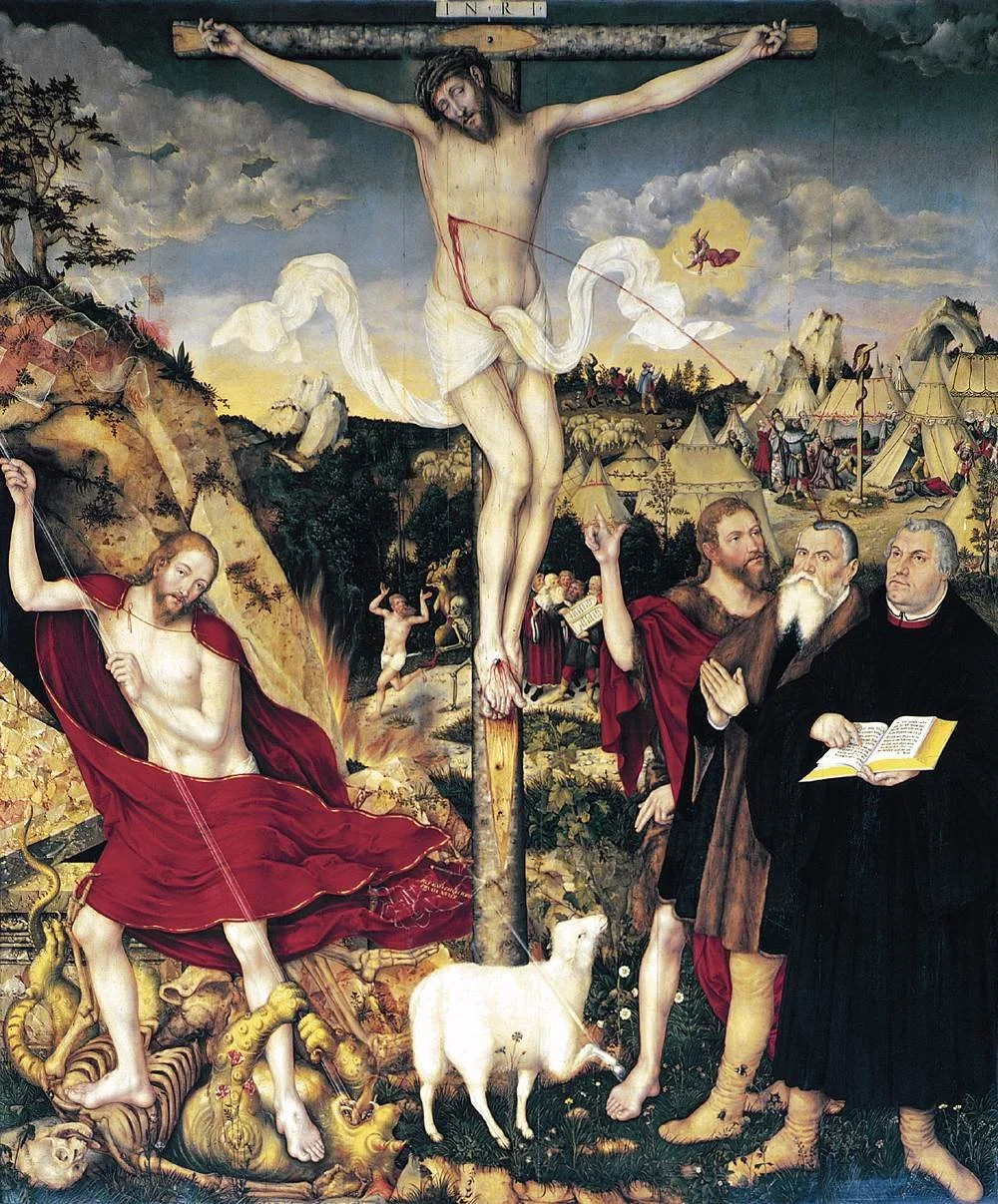
Lucas Cranach the Younger, 1555, Christ on the Cross, part of the Epitaph-altarpiece of Johann Friedrich the Magnanimous in the Weimar parish church St. Peter and Paul. Public domain via Wikimedia Commons.
Then I saw another angel flying directly overhead, with an eternal gospel to proclaim to those who dwell on earth, to every nation and tribe and language and people. And he said with a loud voice, “Fear God and give him glory, because the hour of his judgment has come, and worship him who made heaven and earth, the sea and the springs of water.”
Revelation 14:6-7
When Luther died in 1546 it gave people pause to consider the true impact and emphasis of his life’s work. What was the essence of what he stood for? What was this Reformation really about? What was the lasting message that Luther himself would have people hold on to?
At his funeral, Luther’s friend and colleague Pastor Johannes Bugenhagen preached and while it might be unexpected to our ears today, Bugenhagen identified Luther with the angel of Revelation 14 who proclaimed ‘an eternal gospel’ to all on earth. This was not some schmalzy spirituality suggesting that people become angels when they die (which of course is not true). Rather Bugenhagen was identifying Luther as God’s messenger (angel) whose primary work was to proclaim the unadulterated gospel and to restore it to its rightful place as the central message and work of the church.
As Bugenhagen honoured Luther with this recognition, he was also rightly defining the essence of the Reformation. Still today some want to focus on the impact the Reformation had on history and the way it helped define the German nation, but it was not primarily a cultural or political movement. In fact the Reformation was not a movement, but rather a message (see Pless: 68-69). A message that God freely justifies sinners through faith alone in Christ alone. A message that calls for confidence in the Word of the Lord that endures forever (1 Peter 1:25) and whose central message is this same eternal gospel fulfilled in Christ Jesus who ‘died for our transgressions and was raised for our justification’ (Romans 4:25).
Having emerged from Germany after the ravages of theological liberalism had gutted the church and the two world wars had decimated Europe, the great 20th century Lutheran theologian Hermann Sasse understood this in a way that still needs to be our focus today. He said:
The church in the days of Rationalism failed to exert even the slightest influence upon the world. Liberalism and modernism in the church have made no impression whatsoever upon the world. The Reformation, on the other hand, shook and transformed the world. When does the church exert its greatest influence in the world? When it is church, wholly church, and nothing else! When it brings its message, which is alien to this world, to a world which wants to know nothing of it! This does not imply that the church will then be successful under all circumstances. But the church will never be successful, will never exert any influence upon the world at all, if it runs after the world and attempts to ignore the great gulf which separates it from the world. It is only the church that is alien to this world which shall inherit the earth. (Sasse: Letters to Lutheran Pastors volume 1: 202-203)
The Reformation's 'alien message' may seem strange to the world - but it delivers peace and hope and ultimately salvation; 'For the word of the cross is folly to those who are perishing, but to us who are being saved it is the power of God' (1 Corinthians 1:18). And so, our commemoration of the Reformation must always be a return to this message and a reminder that this message is the church’s one job. Like the angel with an eternal gospel to proclaim, we must continue what Luther began, proclaiming Christ crucified for the forgiveness of sins so that burdened consciences may be freed from shame and guilt and heaven opened to all who believe for Jesus’ sake.
A blessed Reformation to you all!
Pastor Matt Anker
President, Lutheran Mission - Australia
Martin Luther’s funeral sermon can be read here: https://shorturl.at/9pNNI
Pless, John T. Lutheran Confessor. Hermann Sasse on the Essentials of the Faith, CPH, 2026
Sasse, Hermann. Letters to Lutheran Pastors, Ed Matthew C Harrison, CPH, 2014