
The Augsburg Confession – Yesterday, Today and Tomorrow
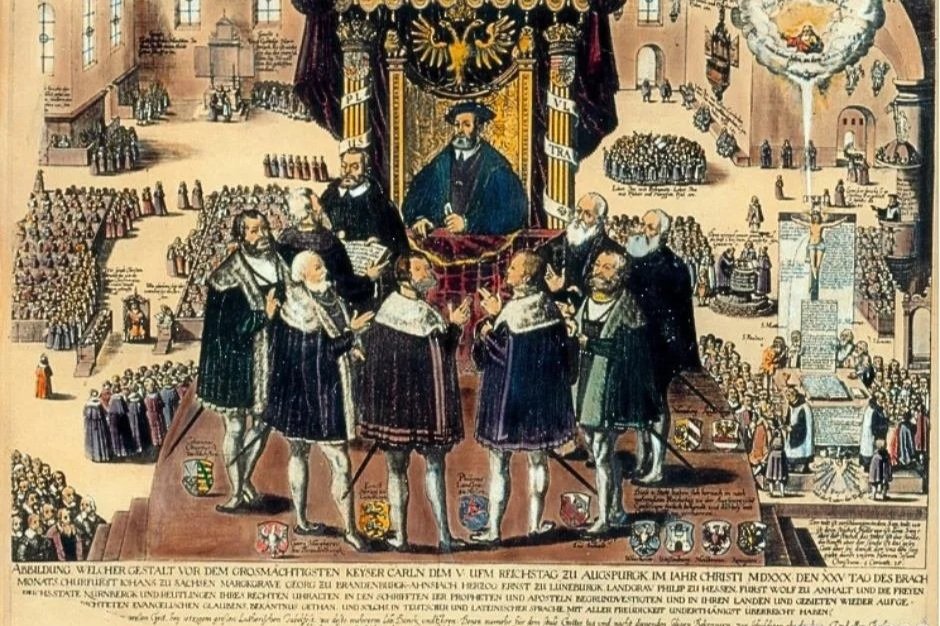
In the early sixteenth century, Emperor Charles V, the Holy Roman Emperor, had several problems. The Turks were threatening his empire, and churchly discord was brewing in his German lands. Some princes and cities were following Martin Luther’s reforms and rejecting the authority of the Pope. In order to help meet the Turkish threat, Charles called a Diet (meeting) of civic leaders in Augsburg in order to resolve the religious disagreements in his realm.
The Elector of Saxony asked the theologians of Wittenberg University to prepare a statement for the Imperial Diet setting out the beliefs and practices followed in his dukedom. The final version of this statement was prepared by Philip Melanchthon – Luther’s key colleague – and presented before Charles on June 25, 1530. The document was signed by seven princes and the representatives of two cities. It has become known as the Augsburg Confession (AC, although it is sometimes abbreviated to CA from its Latin title Confessio Augustana). It consists of 28 Articles.
The confessors at Augsburg weren’t setting out to form a new church – quite the opposite. They saw some of the things happening in the church as abuses. They rejected these abuses – not allowing priests to marry, not giving the bread and the wine in the Eucharist, improper practices in the Mass, the basis of monasticism in works righteousness, for example.
At the conclusion of Articles 1 to 21 – the Articles that deal with teaching and doctrine – we read:
This is about the sum of our teaching. As can be seen, there is nothing here that departs from Scriptures or the church catholic or the church of Rome, in so far as the ancient church is known to us from its writers. Since this is so, those who insist that our teachers are to be regarded as heretics judge too hastily. The whole dissention is concerned with a certain few abuses which have crept into the churches without proper authority.[i]
At the beginning of Articles 22 to 28 – in which ‘an account is given of the abuses which have been corrected,’ the confessors write:
Inasmuch as our churches dissent from the church catholic in no article of faith but only omit some few abuses which are new and have been adopted by the fault of the times although contrary to the intent of the canons, we pray that Your Imperial Majesty will graciously hear both what has been changed and what our reasons for such change are in order that the people may not be compelled to observe these abuses against their conscience.[ii]
Rather than create a new church, the confessors sought to re-form the church in practice and teaching to what they believed it should be. The re-formers at Augsburg wanted the church to get back to faithfully confessing and proclaiming the Scriptures and away from the errors of the medieval church.
The Augsburg Confession was rejected by the authorities. As the conflict between the followers of the Wittenberg reformers and the empire developed, the AC became the fundamental, and founding, document of the Lutheran Reformation. As such, the anniversary of its presentation is rightly celebrated each June 25.
It isn’t a comprehensive theological document – issues that weren’t in contention in the sixteenth century aren’t included. For instance, a doctrine of creation or the Holy Spirit. Neither does it include key Lutheran concerns such as the distinction between law and gospel.
The AC’s major theme is justification – the conviction that:
we cannot obtain forgiveness of sin and righteousness before God by our merit, works, or satisfactions, but that we receive forgiveness of sins and become righteous before God by grace, for Christ’s sake, through faith.[iii]
It is often said that this is the article by which the church stands or falls.
Apart from its pivotal role in the Lutheran confessions, what is the significance of the AC today? Two possibilities come to mind.
Firstly, its ecumenical significance. The AC was written in the hope that it would assist in overcoming church disunity. It is open for the Roman Catholic church to recognize the Augsburg Confession. Not as its own confession, but that the Catholic church could be in fellowship with those who uphold the AC. In 1977, in the run up to the 450th anniversary of the presentation, Joseph Ratzinger – later Pope Benedict XVI – said: ‘Efforts are under way to achieve a Catholic recognition of the CA as catholic, and thereby to establish the catholicity of the churches of the CA, which makes possible a corporate union while differences remain.’ [iv]
Benedict was ahead of his time. More recently, in 2021 Pope Francis noted AC’s ecumenical potential saying:
The Augsburg Confession represented an attempt to avoid the threat of division in Western Christianity … [and that] shared reflection on the Augsburg Confession in view of the five-hundredth anniversary of its reading, 25 June 2030, may benefit our ecumenical journey. [v]
This call has been taken up by the International Lutheran Council – of which LM-A is a member. In 2013, the ILC and the Pontifical Council for Promoting Christian Unity agreed to establish ecumenical discussions between the two traditions. These began in 2014 and have included discussions around the AC.
Mathew Block, Communications Manager for the ILC, notes: As we move toward the 500th anniversary of the Confessioio Augustana in 2030, then, it is clear that interest in the ecumenical value of the CA is again on the rise [vi].
He concludes:
It is the duty of every Christian to pray for the unity of the Church, seeking it in the truth of God’s Word – just our Lord himself prayed for the unity of the Church in John 17. We should take advantage of the current moment to take up anew the ecumenical call of the Augsburg Confession, clarifying misconceptions where they may exist and striving for greater consensus as we listen to each other “charitably, amicably, and with mutual graciousness” – seeking, under God’s direction, the “unity and concord” of the Church which dwells” under one Christ”. [vii]
The second significance of AC is that it shows we must ensure we don’t just go along with ’some few abuses which are new and have been adopted by the fault of our times’. That we have always to be alert to where the church needs to be re-formed.
The Augsburg Confession is a treasure for Lutherans and for all with ears to hear, as it holds before us the gift of forgiveness for the sake of Christ alone and offers a good conscience to those who would trust in Him for all that is needful.
by Mervyn Wagner
2026
[i] Tappert 47:1,2
[ii] Tappert 48-9: 1
[iii] Tappert, 30:1
[iv] Cited in Mathew Block, ‘The Augsburg Confession as a Catholic Statement of Faith: Ecumenical Efforts by Catholics and Lutherans since the 20th Century’, Lutheran Theological Review, 37, (2025) p 8
[v] Cited in Block, p 27-8
[vi] Block, P 31-2.
[vii] Block, P 32.