
Articles
Feature Article
The Augsburg Confession – Yesterday, Today and Tomorrow
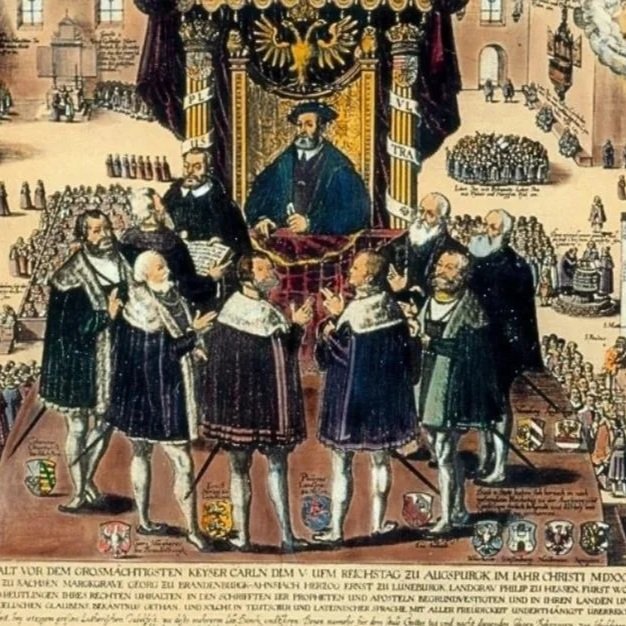
In the early sixteenth century, Emperor Charles V, the Holy Roman Emperor, had several problems. The Turks were threatening his empire, and churchly discord was brewing in his German lands. Some princes and cities were following Martin Luther’s reforms and rejecting the authority of the Pope. In order to help meet the Turkish threat, Charles called a Diet (meeting) of civic leaders in Augsburg in order to resolve the religious disagreements in his realm.
The Elector of Saxony asked the theologians of Wittenberg University to prepare a statement for the Imperial Diet setting out the beliefs and practices followed in his dukedom. The final version of this statement was prepared by Philip Melanchthon – Luther’s key colleague – and presented before Charles on June 25, 1530. The document was signed by seven princes and the representatives of two cities. It has become known as the Augsburg Confession (AC, although it is sometimes abbreviated to CA from its Latin title Confessio Augustana). It consists of 28 Articles.
The confessors at Augsburg weren’t setting out to form a new church – quite the opposite. They saw some of the things happening in the church as abuses. They rejected these abuses – not allowing priests to marry, not giving the bread and the wine in the Eucharist, improper practices in the Mass, the basis of monasticism in works righteousness, for example.
At the conclusion of Articles 1 to 21 – the Articles that deal with teaching and doctrine – we read:
This is about the sum of our teaching. As can be seen, there is nothing here that departs from Scriptures or the church catholic or the church of Rome, in so far as the ancient church is known to us from its writers. Since this is so, those who insist that our teachers are to be regarded as heretics judge too hastily. The whole dissention is concerned with a certain few abuses which have crept into the churches without proper authority.[i]