
To God be the Glory
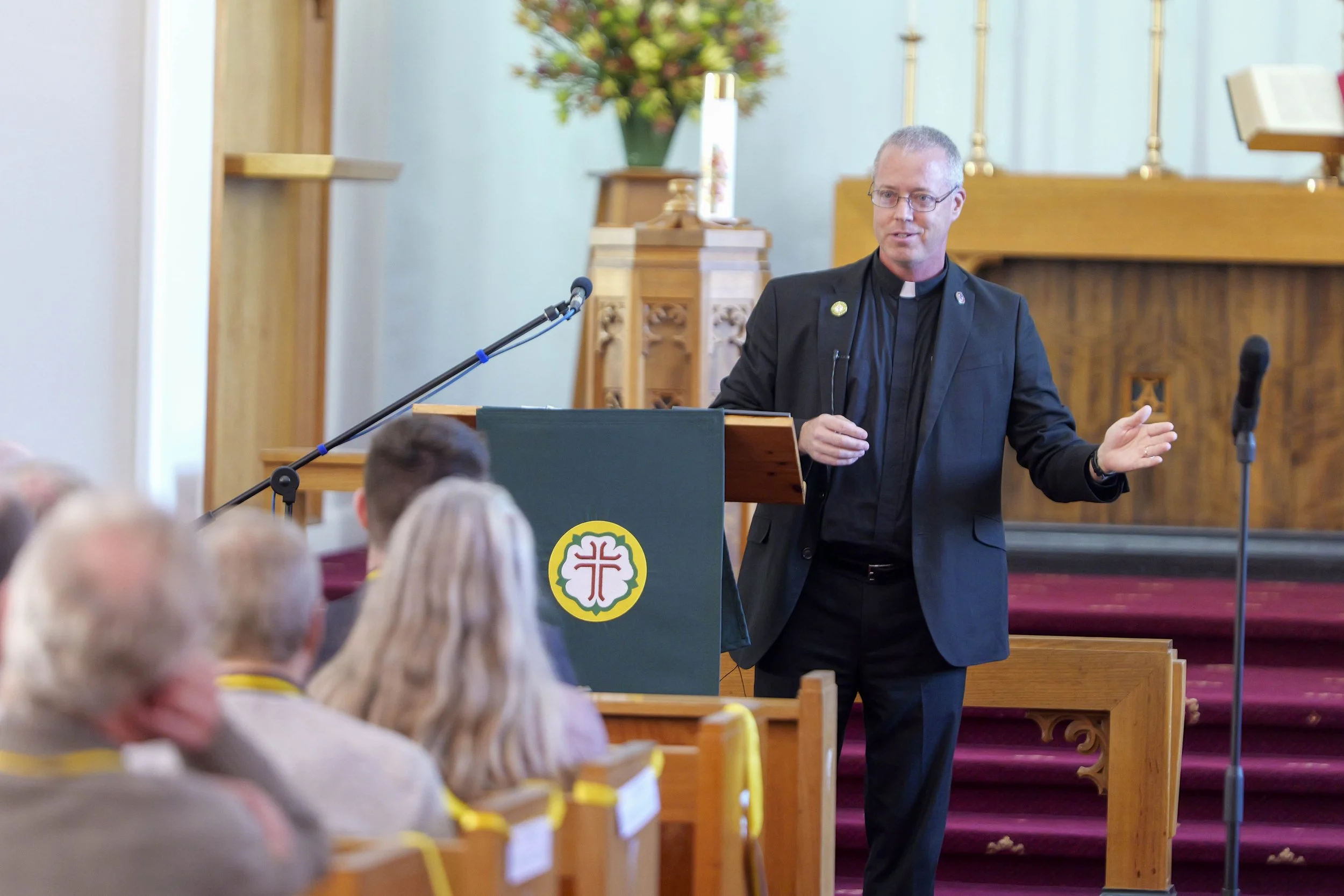
Rev. Michael Frese presenting his excellent Bible Study.
A highlight of the Synodical Assembly was the in-depth teaching provided on Friday and Saturday by Rev. Michael Frese, who serves as the Deputy Director of Church Relations for The Lutheran Church - Missouri Synod. Pastor Frese presented a detailed Bible Study on the topic, ‘If Moses Had Glory, How Much More Christ? A Biblical and Confessional Case for Reverent, Liturgical Worship from 2 Corinthians 3:7–11.’
Speaking with warmth and enthusiasm, Pastor Frese shared how he came to love the liturgy when a professor in college took the time to show him how the forms and words we use in worship come from the Bible. ‘It was eye-opening - it blew my mind!’ In the same class, he learnt how these forms originated in the Old Testament, how they were developed through the New Testament and then through the Early Church and the Middle Ages. Using the historic forms reminds us that we are worshipping with all the saints who have gone before us.
Pastor Frese taught that the liturgy brings us into the presence of God to receive His gifts. In worship, God condescends to come to us. We meet Him around His altar in Holy Communion, and when the Word is read and preached. ‘The liturgy brings us into close relationship with God - here we have God speaking, calling us to share in the gospel. Having received this gospel, our hearts are changed. Then our hearts, filled with the Holy Spirit, have the motivation to respond to that great gift.’ This is worship; God gives, and we respond.
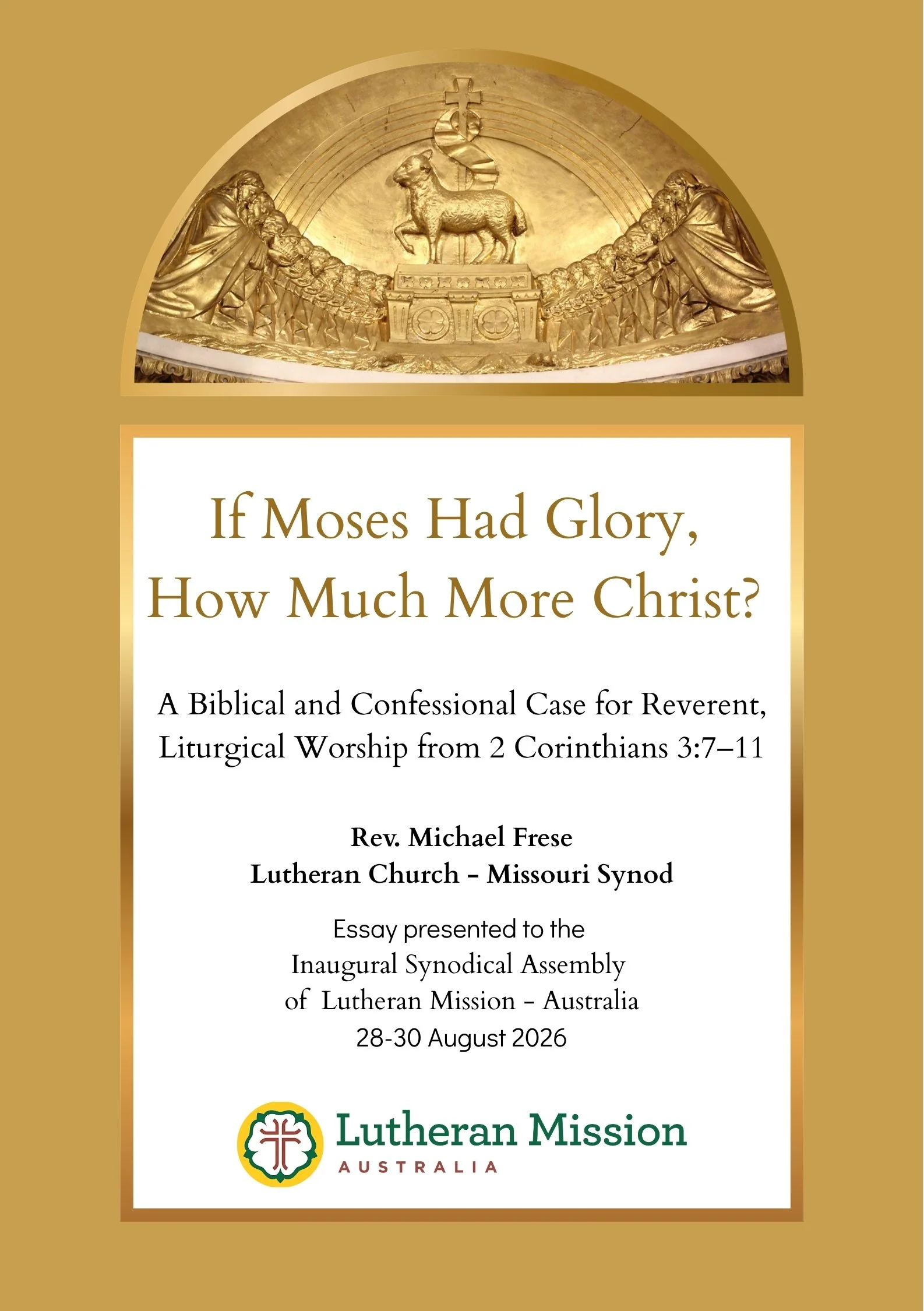
Pastor Frese’s essay was printed and given to member representatives as a gift. A PDF copy may be downloaded below.
Describing the pressure pastors often face to change the service and remove traditional forms, Pastor Frese moved into the content of his essay, which readers can download and read in full at the end of this article.
In summary: historical liturgical worship has been challenged by those who say that this style of worship is not necessary because we now have the freedom of the Gospel to worship however we see fit and are no longer bound by the Old Testament rules commanding worship. While it is true that Christ removed the Mosaic obligations such as the sacrificial system, Frese argues that the ‘question behind the question’ is based on the premise that ‘the New Testament has made God essentially indifferent to the form of worship, and that the chief criteria for Christian worship are sincerity, approachability, or utility.’
The essay begins by examining Levitical worship, and what it reveals about God’s attitude towards how He is worshipped. In St Paul’s teaching in 2 Corinthians 3, the apostle points out that if in the Old Testament the law (‘the ministry of death’) ‘came with such glory that the Israelites could not gaze at Moses’ face because of its glory’, how much more glorious is the ‘ministry of the Spirit’, now that God has revealed himself through the life, death and resurrection of Christ?
Frese draws St Paul’s principle to this conclusion; ‘the New Testament removes the obligation of Mosaic forms because they have been fulfilled, but it does not remove (and in fact intensifies) the divine concern for reverent, ordered, and beautiful worship in the very presence of God.’ The worship described in Revelation 4-5 reinforces this point, revealing worship that is ‘strikingly liturgical’.
Frese then examines the Lutheran Confessions and the work of modern theologians. Noting that the Reformers ‘were not liturgical minimalists’, Frese notes that the Augsburg Confession supports the retention of ceremonies and practices which add to the ‘tranquillity and good order’ of the Church, so long as they can be observed without sin (Article XV 1), and that ‘the Mass is held among us with the highest reverence’ (AC XXIV 1-2). The important distinction they taught was that ceremonies do not justify. This does not mean that ceremonies are wrong or should be abandoned altogether.
Frese concludes
The Lutheran church therefore does not worship with studied carelessness or liturgical minimalism as though evangelical freedom were ceremonial indifference. Rather, she worships with evangelical freedom directed toward an even greater Mystery — the crucified, risen, and present Lord Jesus Christ, Emmanuel (God with us), — joining her voice to the unceasing song around His throne (Rev. 4–5), all things done decently and in order (1 Cor. 14:40). God has never been indifferent to the manner of His worship, relegating the principle to a matter of adiaphoron. The New Covenant does not reduce that concern; it fulfils and surpasses it. The liturgy of the church is not a prison restricting evangelical freedom; it is a gift ordered by the same wisdom that clothed the tabernacle in gold and arrayed the Levites in white linen, now serving a far greater and more present Glory.