
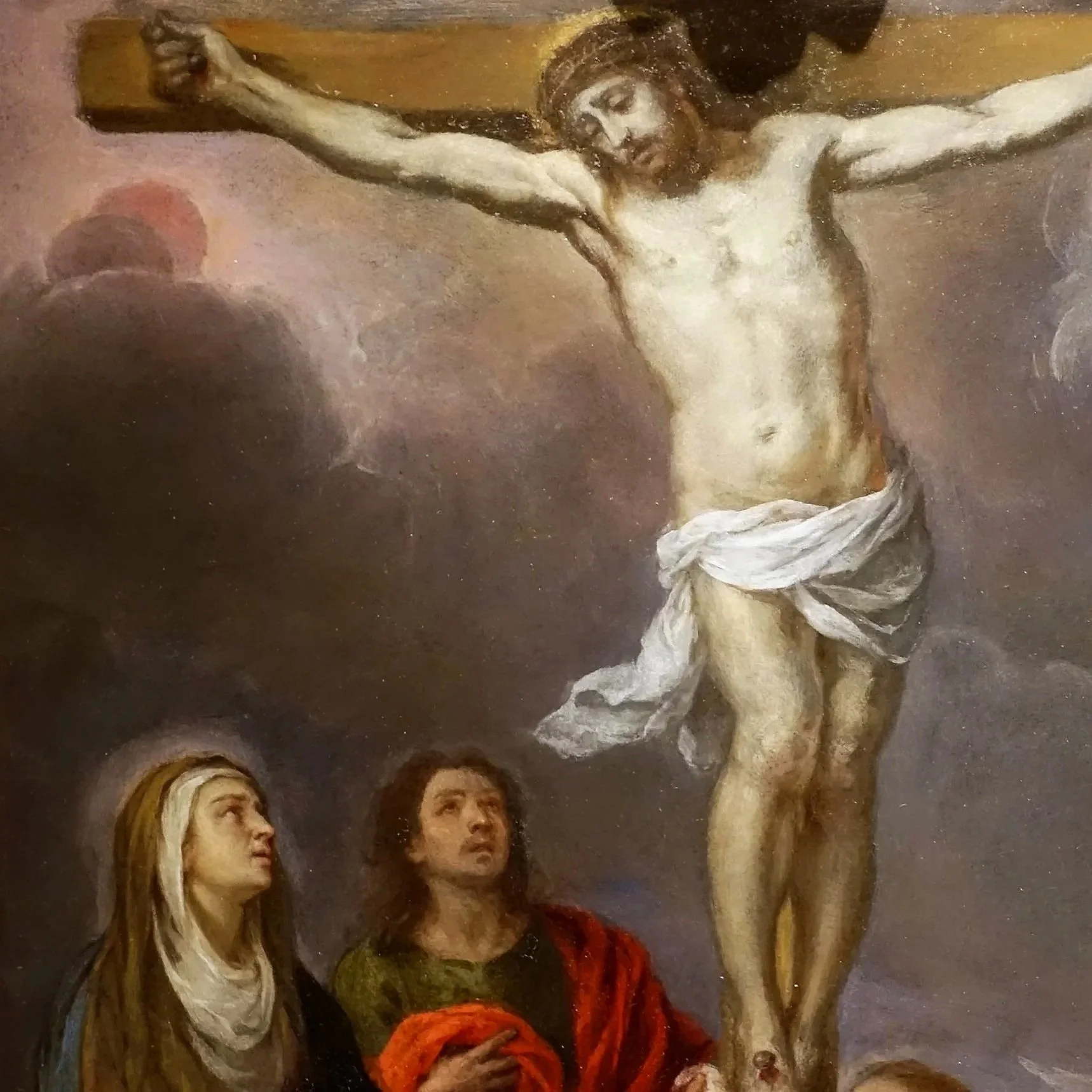
Christ on the Cross with the Virgin, Mary Magdalene, and Saint John, by Bartolome Esteban Murillo, Spanish, c. 1670 Public Domain, via Wikimedia Commons
When Jesus saw his mother and the disciple whom he loved standing nearby, he said to his mother, “Woman, behold, your son!” Then he said to the disciple, “Behold, your mother!” And from that hour the disciple took her to his own home.
John 19:26-27
As the first-born son, Jesus fulfilled the command and obligation to meet the ongoing needs of His widowed mother (Exodus 20:12; Psalm 68:5; 1 Timothy 5:3-4; James 1:27), not by entrusting her care to unbelievers (John 7:5), but to a member of the family of the Faith, His beloved disciple John. And ‘from that hour the disciple took her into his own home’ (John 19:27).
Mary, the mother of our Lord, was the most blessed among women, for she received the unique privilege of being the mother of God. But great sorrow was attached to this great blessing. The suffering and death of her Son was the sword that pierced her soul (Luke 2:35b). She treasured up everything that was revealed to her about her Son by the shepherds at His birth. She treasured these things, but it would take the resurrection of her Son for her to understand everything that took place, just as it would for all the other disciples.
In the third word from the cross, “Woman, behold, your son!” and "Behold your mother," Jesus withdraws Himself from His mother in order that she may see in her son, the Son of God. As at the Wedding in Cana (John 2:1-11) we may think that Jesus’ use of the name ‘woman’ rather than ‘mother’ is harsh. But it is precisely because Jesus loves Mary that He must now sever any and all motherly claims on Him and place her into the same position of the penitent thief on the cross who had no temptation to a familial claim. Edmund Schlink wrote, “We may make claims on a son but not on God. We can look on a son, but never on God, as our own. God demands us as His own, and He makes one-sided claims” (from Schlink, E. The Victor Speaks, trans. Paul F. Koehneke, CPH, Saint Louis, 1958, p21). Joseph had died, so Jesus leaves His mother as a man must if He be wedded to His Bride (Gen 2:24) to form His own household, the Church.
There was a woman who called out to Jesus, "Blessed is the mother who gave you birth and nursed you." But He replied, "Blessed rather are those who hear the word of God and obey it" (Luke 11:27-28). Again, we see Jesus withdrawing His sonship to His mother in order to emphasize His Sonship with His Father in heaven. Schlink reminds us that, ‘It is not the son of Mary who is the Son of God, but it is the Son of God who became the Son of Mary!’ (ibid, p21).
Paul said, ‘But if anyone does not provide for his relatives, and especially for members of his household, he has denied the faith and is worse than an unbeliever’ (1 Timothy 5:8). There is an old saying that goes, ‘You can choose your friends, but you can't choose your family.’
This third word from the cross reveals God's perfect plan for mutual care and concern in the family of faith. Anglican priest and author of the hymn ‘Onward, Christian soldiers,’ S. Baring-Gould points out that the commendation of Mary to John and of John to Mary, to care for each other in the household of faith, is a little like a wedding where bride and groom pledge to be together 'til death do they part'. Just as Noah in reverent fear built the ark to save his family (Hebrews 11:7), so Mary is likewise brought into the ark, that is, the house of John, for her care and protection. God's plan is for us to love and care for each other, as Christ, the Bridegroom, loves and cares for His Church. In Christ's case, even death cannot part us from our Groom.
God gifts each Christian with a larger family, the congregation. Jesus said, “Here are my mother and my brothers! For whoever does the will of God, he is my brother and sister and mother” (Mark 3:34-35), and He promised saying, “Truly, I say to you, there is no one who has left house or brothers or sisters or mother or father or children or lands, for my sake and for the gospel, who will not receive a hundredfold now in this time, houses and brothers and sisters and mothers and children and lands, with persecutions, and in the age to come eternal life” (Mark 10:29-30). Again, Edmund Schlink notes, ‘By binding His mother to the disciple and the disciple to His mother, the crucified Christ directs her into the communion of believers in which we find a grateful Mary after Easter’ (ibid, p23).
What the world needs most is not ‘family churches’, but rather ‘church families’. Faith in the crucified and risen Christ binds the congregation together more deeply than biology ever could. Into the family's and into the world's pain, into its sense of loss and into its misplaced fear of an unknown future, Jesus lovingly said from the cross, "Woman, here is your son," and "Here is your mother” and thereby creates our communion with God.
Merciful Lord Jesus Christ,
As You hung upon the cross, bearing the sin of the world,
You did not forget Your mother.
In Your suffering, You still loved.
In Your agony, You still provided.
Lord Jesus, You who formed a new family at the foot of the cross,
bind us together in true communion.
Deliver us from shallow ties and draw us into the deep fellowship
that flows from Your pierced side.
Help us to hear Your Word and keep it,
that we may be counted among Your brothers and sisters —
not by blood, but by faith in You,
crucified and risen.
Into Your gracious care we commend ourselves,
our households, and Your Church,
for You live and reign with the Father and the Holy Spirit,
one God, now and forever.
Amen.